![]() |
|
Contents |
Opinion/Articles
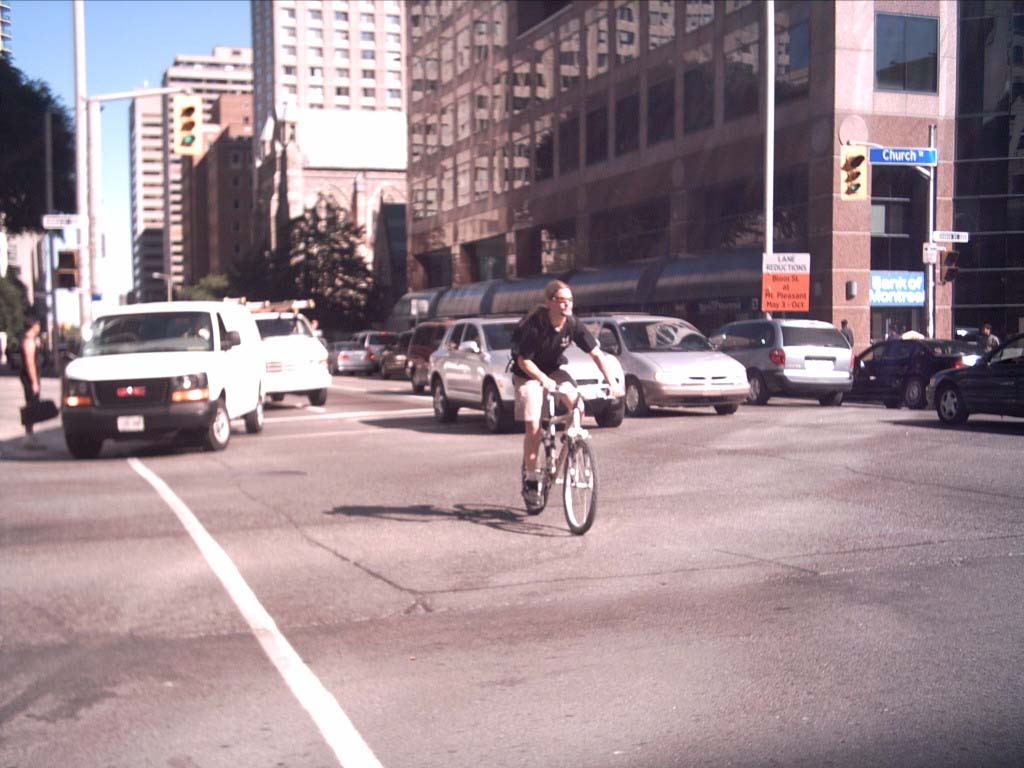
Transportation - CyclingBicycling ...May 2004 A sustainable mode of transportation. Respected and successfully incorporated in city infrastructures of Europe, bicycling has been a bone of contention in Canadian cities where the car has been considered the pivotal mode of transportation while cycling is looked upon as an unavoidable inconvenience. The environmental design of Copenhagen's infrastructure, Europe's best known city for its extensive bicycling corridors, has been acclaimed for its successful system of transportation and public spaces. The mode of transportation is divided equally in three parts: public transit, private cars, and cycling. Cycling is part of life style. In Canada, Ottawa devotes 65km to cyclists and joggers every Sunday from May 19 to September 1 by closing streets and parkways to motorized vehicles. Both residents and tourists enjoy "Sunday Bike Day". In Toronto, when this initiative was introduced to the Urban, Environment & Development Committee April 19, 1999, it was referred to the Toronto Cycling Committee where it was simply "received". Why does the Toronto Cycling Committee fail to act upon initiatives that promote and increase cycling by all means? Every bike lane has to be endlessly debated and fought for against city officials' opposition and adverse reaction, because of a preconceived notion that bicycle lanes impose a disruption on traffic even though the bicycle is a vehicle, and therefore a legitimate component of traffic. They have studied and discussed the ever familiar Bike Plan since the mid '70s , giving it a new name every ten years and a renewed time-line to give the impression of a new project; but in fact, going nowhere fast. Councillor Adam Giambrone informed cyclists at the Community Bicycle Network meeting he attended February 2, 2004 that the new plan (yet again an always new plan) will take another 20 years to implement comprehensively.... Brings to mind Penelope's weaving... The North American automobile accommodating mentality has been counterproductive environmentally and economically, and unsuccessful in alleviating congestion by effectively promoting and funding alternative sustainable modes of transportation. So far we have subsidized the automobile in the tune of millions of dollars per year ignoring public and human costs that this unrestrained mode of transport has imposed on society. Urban design in Toronto failed to incorporate cycling efficiently and prominently, and the council's dilatoriness in taking decisive action has created hazardous conditions for all. Traffic violations and disregard of Municipal By-Laws in law enforcement has produced 58% pedestrian traffic fatalities in 2003, and 13 cycling fatalities of 6,388 collisions from 1998 to 2002. According to Toronto Police, Traffic Services Unit, unless a violation is a criminal act, traffic violations fall under the HTA. No reference was made to Municipal By-Laws in conjunction with HTA. Will North American cities ever come up to par with the (bike-friendly) progressive and innovative cities of Europe? |