Transportation - Cycling

Toronto's imbalanced transportation

May 2010

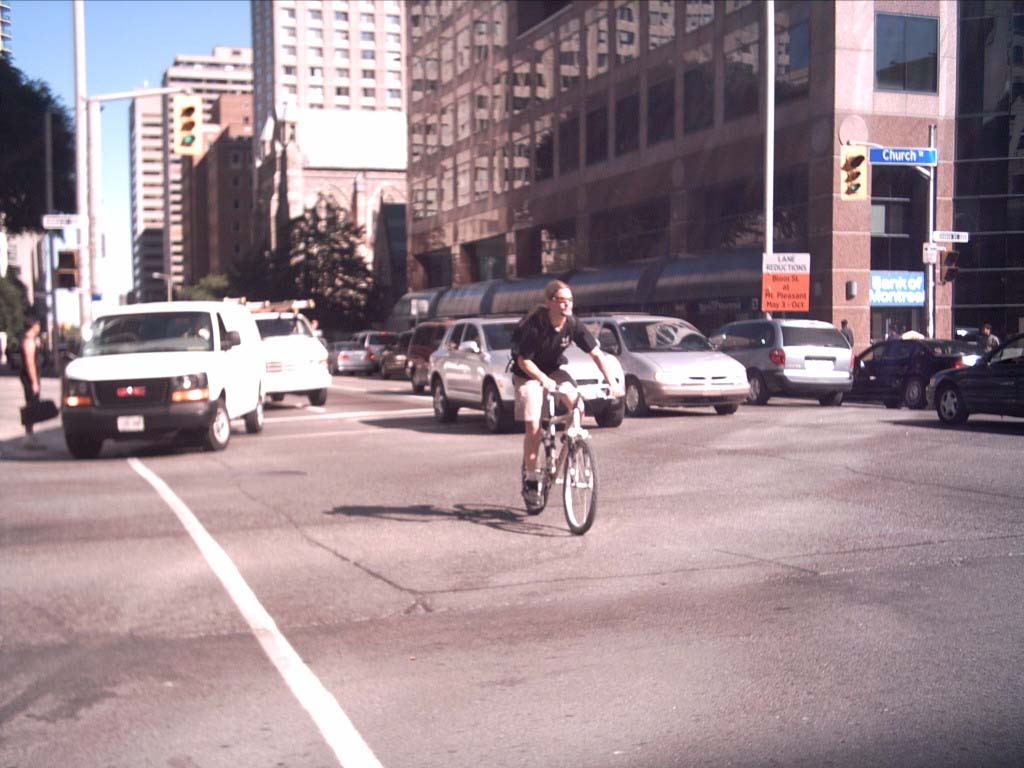
The proposed bike lane on University Avenue between Wellesley street and Richmond fizzled out to the detriment of many cyclists, by a fluke voting. But, perhaps it was a blessing in disguise!

This short lane, less than 2 kms, however safety-wise was designed, it was ill-planned as to the starting and ending nowhere point, to have and demonstrate any benefit. In fact it was ineffective as most planning in Toronto has been, by resorting to tokenism. Tokenism has never developed into progress; indeed, it has thwarted it. Cyclists shun unsafe and unconnected lanes that lead to nowhere. How many drivers would you see on a two killometer traffic lane going nowhere?

Assertions of traffic gridlock that bike lanes would cause in Toronto by politicians, drivers and even media, reflect the ever economically and environmentally counterproductive mentality that the car is the pivotal mode of transportation, ignoring the fact that the bicycle is a vehicle and therefore a legitimate component of traffic.

Auto-transport, the most unsustainable and costly mode of transportation, has been the classic externality example as it has not incorporated a cost/benefit analysis of the broad range of factors regarding health, economic, environmental, and social costs. Underpriced auto-transport has created inefficient and unbalanced mobility by increased traffic and inequity. In a report by Ecopolitics on the Cost of the car on society, in Infrastructure vs Economics, 2006, extensive list of costs on health in hospital admissions, economy, land space, are listed. Lost productivity is projected to be $9,846,522,700 by 2015. Traffic has been the main source of air pollution in car-clogged cities like Toronto, and the cost of our economy in health, congestion, and productivity will exceed $9billion this year.

In Toronto there is no transportation balance because there has not been Mobility management to decrease auto-travel and gridlock by integrating alternative modes of transportation. Instead, an older automobile-oriented planning has been in effect which limits a broad range of objectives, impacts and options. Strategies to that effect have been proposed by the Victoria Transport Policy Institute (VTPI) in their report, Are vehicle travel reduction targets justified? 2010.

Toronto has never implemented an integrated and cohesive plan on bike lanes to achieve successful mobility. Yet, according to a survey by the City of Toronto, 2010, a majority of residents age 15 years and older ride bicycles (54 per cent) and they are using them for more than just recreation. An Environics International Ltd. Survey indicated that 70% of Canadians would definitely bicycle to work if they had access to a dedicated bike lane. A large majority in Canada (82%) supports government spending to create dedicated bike lanes to encourage safe cycling and healthy lifestyle.

There will be no progress in mobility if politicians with vested interests in ignoring transportation and environmental reports insist on placating the equally self-serving populace at the expense of social equity and sustainability. Neither is the Neo-Conservative plan progressive in their semantic support for bike lanes, as long as they are being ostracised to park paths, out of the way of main roads. This mentality is what created the imbalanced and costly transportation system in Toronto.